A liver transplant replaces a diseased liver with a healthy one from a donor. It is a major operation that can save the life of a person with cirrhosis or other end-stage liver disease[c2]. In India most liver transplants use a living donor, usually a close relative who gives part of their liver[c4]. This guide explains who needs a transplant, how living and deceased donor transplants differ, what the law requires of international patients, what outcomes have been reported in India, and what it costs.
Medical disclaimer: This content is for general awareness and does not replace a doctor’s consultation. For diagnosis or treatment decisions, consult a qualified specialist.
Want a free hospital opinion and cost estimate?
Send your reports on WhatsApp or online. We check with accredited transplant centres whether you may qualify, what the donor requirements are for your situation, and what the package would cost.
Chat on WhatsAppSend reports online
Or message us on +91 74002 20146. Useful to send: your diagnosis, latest blood tests and scans, treatment so far, your age and your country.
Who Needs a Liver Transplant
A transplant is considered when the liver can no longer do its job and other treatment has not worked or is no longer enough. Common reasons include:
- Cirrhosis with complications such as jaundice, fluid in the abdomen (ascites) or confusion from liver failure (hepatic encephalopathy).
- Acute liver failure, where the liver fails suddenly because of toxins, medicines or viral infection.
- Liver cancer that is still confined to the liver but cannot be removed by ordinary surgery. See our guide to liver cancer treatment in India for the other options.
- Bile duct diseases such as primary biliary cholangitis and primary sclerosing cholangitis.
- Inherited liver diseases, including Wilson's disease.
The transplant team decides whether you are a candidate after assessing liver function, your general health, and whether you have the support at home to manage life after surgery. Active infection or a recent cancer elsewhere in the body usually rules a transplant out for the time being.
Living Donor or Deceased Donor
| | Living donor (LDLT) | Deceased donor (DDLT) |
|---|
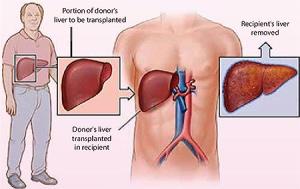
| Where the liver comes from | Part of a healthy person's liver, usually a close relative; the liver regrows | A whole liver (or one split between two recipients) from a donor declared brain-stem dead |
| How common in India | The majority of liver transplants in India[c4]; one study states over 80%[c3] | Less common, and concentrated in a few regions[c4] |
| Timing | Can be planned once donor and patient are both assessed and approved | Depends on a suitable donor becoming available |
| Open to international patients? | Yes, with a qualifying donor and legal approval (see below) | Limited: organs go to Indian patients first[c7] |
How safe is it for the donor?
Donating part of a liver is a major operation. In a series of 275 living donors at one large Indian centre, two-thirds had no complications, and major complications occurred in 4.36% of donors[c5]. Every donor is assessed separately from the patient.
Rules for International Patients
India's Transplantation of Human Organs and Tissues Act regulates organ transplants and prohibits commercial dealing in organs[c1]. For a foreign patient this means:
- The donor normally has to be a near relative. The law lists mother, father, son, daughter, brother, sister and spouse, and the 2011 amendment added grandparents and grandchildren[c1].
- A donor who is not a near relative can donate only out of affection and attachment or another special reason, and only with the approval of the hospital's authorisation committee[c1].
- Foreign nationals get closer scrutiny. The Act provides for greater caution in cases involving foreign nationals[c1], and every registered hospital must have a transplant coordinator[c1]. The coordinator tells you which documents the committee needs, such as proof of identity and of your relationship with the donor.
- Deceased-donor livers go to Indian patients first. As reported from NOTTO's 2023–24 annual report, deceased-donor organs are allocated to foreigners only when no matching Indian patient is available[c7]. In practice, most international patients plan for a related living donor.
Warning signs. Anyone offering you a donor, a liver with no wait, or a way around the committee is asking you to break the law. Buying or selling an organ is prohibited, and it puts your health and your donor's at risk. A genuine hospital will take you through the committee process.
Outcomes Reported in India
Outcomes depend on why you need the transplant, how sick you are beforehand, the type of donor, and the centre. Two sources give an idea of the range:
- India, deceased-donor transplants. A report of 362 deceased-donor liver transplants across 11 centres in Tamil Nadu, from 2010 to 2019, found adult survival of 87.2% at one year, 80.4% at three years and 76.6% at five years. Survival in children was 80.6% at each point[c3].
- United States, all transplants (registry data). The US transplant registry records mortality of 6.5% at one year and 19.0% at five years after liver transplant[c6]. These are US figures, shown for comparison.
The Indian figures describe one state's programme, not every hospital. We do not quote a single "success rate" because it would hide the differences between patients and centres. Ask each hospital for its own survival figures for patients like you.
Liver Transplant Cost in India
Our reference range for an all-inclusive living-donor liver transplant package for an international patient is ₹24,00,000–₹38,00,000 (about $25,000–$40,000). Deceased-donor packages are higher, about $30,000–$50,000 (₹29–48 lakh).
About these prices: all-inclusive package estimates for international patients at accredited private hospitals, compiled in September 2026 from published hospital and facilitator price lists (about ₹96 per US dollar). Indian residents are usually quoted lower domestic tariffs; your final cost is confirmed after a specialist reviews your reports.
What pushes a quote up: a longer ICU stay, complications, a sicker patient, and a private room. Ask what the package includes, what happens to the price if there are complications, and how follow-up medicines are billed. Our liver transplant cost guide breaks the costs down further.
Explore a detailed breakdown of liver transplant cost in India by visiting our in-depth guide liver transplant cost in India.
The Process, Step by Step
- Send your reports. The centre reviews your scans, blood tests and history and tells you whether a transplant is likely to be suitable.
- Evaluation in India. You and your donor are assessed separately: liver function, imaging, heart and lung checks, and infection screening.
- Legal approval. The hospital's transplant coordinator prepares the documents and the authorisation committee reviews them. Surgery cannot go ahead without this step.
- Surgery. Your diseased liver is removed and the donor's liver is connected to your blood vessels and bile ducts. After surgery you are monitored in intensive care.
- Hospital recovery. Your team watches for rejection, infection and bile problems and begins your anti-rejection medicines. Ask the hospital how long it expects you to stay.
- Follow-up in India. You usually need to stay near the hospital for a period after discharge for regular blood tests, until the team is satisfied you can travel.

Risks and Life After Transplant
- Rejection: the immune system can attack the new liver. It is treated with medicines, and often shows up first on blood tests before symptoms such as fever, jaundice or abdominal pain.
- Infection: anti-rejection medicines weaken your defences, so infection is a main risk, especially early on.
- Bile duct problems and bleeding: complications at the connections made during surgery, sometimes needing a further procedure.
- Medicine side effects: long-term anti-rejection drugs can affect the kidneys and bones and raise the risk of some cancers, so they are monitored.
You will take anti-rejection medicine for life and need regular check-ups, blood tests and scans. Avoiding alcohol and keeping a healthy diet protect the new liver. Plan how you will continue care at home: ask the hospital for a written summary and medicine plan that your local doctor can follow.

Choosing a Transplant Centre
Private hospitals in India that run liver transplant programmes include Apollo Hospitals in Chennai, Medanta in Gurgaon, Max Saket in Delhi and Fortis in Bengaluru. Programmes change, so confirm each hospital's current team and results rather than relying on a list. Questions worth asking any centre:
- How many living-donor and deceased-donor liver transplants do you perform each year?
- What is your one-year survival for patients with my condition, and how do you measure it?
- Do you have a dedicated transplant ICU and a full-time transplant coordinator?
- Which surgeon will operate on me and on my donor?
- What does the package include, and what is billed separately if there are complications?
- Is the hospital accredited (NABH or JCI), and for which departments?
Not sure which centre fits your case?
Send us your reports. We ask transplant centres for their opinion, their donor requirements and their package price, and give you the answers side by side, so you can decide with the facts.
Chat on WhatsAppSend reports online
Planning Travel from Abroad
You will need a medical visa and a letter from the hospital. Our e-Medical visa guide explains the process, validity and the limit of two attendant visas. It was written for cancer patients, but the same visa and hospital-letter rules apply to other medical treatment. Your donor will also need to travel, so ask the hospital and the Indian mission which visa applies to them. Plan to be in India for the evaluation, the approval process, surgery and the follow-up period, and ask the hospital for a realistic timeline in writing.
Frequently Asked Questions About Liver Transplant in India
How much does a liver transplant cost in India?
For international patients our reference range is ₹24–38 lakh (about $25,000–$40,000) for a living-donor package, and about $30,000–$50,000 for a deceased-donor package, at accredited private hospitals.
Can a foreign national have a liver transplant in India?
Yes, usually with a related living donor and with approval from the hospital's authorisation committee[c1]. Deceased-donor livers are allocated to Indian patients first[c7].
Who can donate part of their liver to me?
Normally a near relative: parent, child, sibling, spouse, grandparent or grandchild[c1]. A donor outside this group needs the authorisation committee's approval[c1].
Is it safe for the donor?
It is a major operation with real risks. In 275 donors at one Indian centre, two-thirds had no complications and major complications occurred in 4.36%[c5]. Donors are assessed independently of the patient.
What is the survival rate after liver transplant in India?
In a report of 362 deceased-donor transplants in Tamil Nadu, adult survival was 87.2% at one year and 76.6% at five years[c3]. Results vary by centre and patient, so ask the hospital for its own figures.
How long will I wait for a liver?
With a living donor, the date depends on completing the evaluations and legal approval for both of you, not on a waiting list. For deceased donors the wait is unpredictable, and international patients are not first in line[c7].
How long does recovery take?
You will spend time in intensive care and then on the ward, and you should expect to stay near the hospital for follow-up before travelling home. Your surgeon will give you timings based on your progress; full recovery takes months.
Do I have to take medicine for life?
Yes. Anti-rejection medicines are needed for as long as you have the transplanted liver, with regular monitoring.
How do I avoid transplant scams?
Deal only with accredited hospitals, never pay anyone for an organ, and expect a documented approval process. Organ trading is illegal in India[c1].
About This Guide
ArogyaJivan is a medical travel information and enquiry service. We are not a hospital and we do not perform transplants. Decisions about whether you can have treatment, and what treatment you need, are made by the doctors at the treating hospital. This page is general information, not medical advice, and it does not replace advice from your own doctor. Prices are estimates and are confirmed by the hospital after it reviews your reports.
Planning Liver Transplant in India?
Share your reports and our care team will come back with suitable
hospitals, indicative costs and an outline treatment plan. No cost, no obligation.
Prepare mentally and emotionally for liver transplant surgery with comprehensive support, counseling, and resilience-building strategies. Mental and Emotional Readiness for Liver Transplant Surgery
Recognizing signs like jaundice, fatigue, and encephalopathy early can indicate the need for a liver transplant, potentially saving lives. Signs That Indicate You May Need a Liver Transplant Soon
Explore the critical distinctions and implications between emergency and elective liver transplants, enhancing patient understanding and preparedness. Emergency vs. Elective Liver Transplants: What’s the Difference?